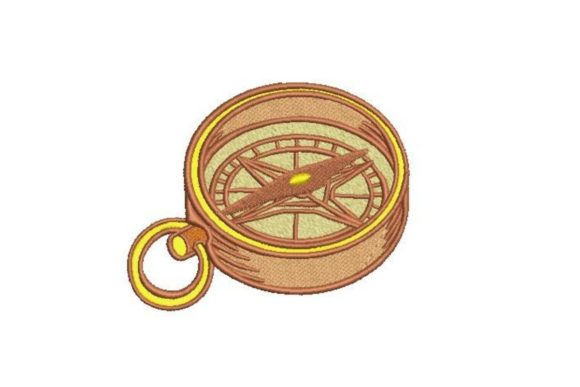
Compass Embroidery Design Review
First Impressions: A Clean, Travel-Ready Motif
As someone who’s digitized and stitched over 300 travel-themed designs for Etsy sellers and boutique apparel brands, I opened Compass with a specific question: does it feel like a design built for real-world use—or just another decorative clipart-style motif? Right away, I noticed its balanced composition: clean outer ring, subtle directional markings, and a centered needle that avoids overly fussy detail. It reads as confident—not too ornate, not too minimal. The visual mood is quietly adventurous: grounded, intentional, and welcoming to both minimalist and rustic handmade aesthetics. It’s clearly designed as a machine embroidery design, not a vector graphic repurposed for stitching. That matters—especially when you’re stitching on textured fabric or curved surfaces.
Where Compass Fits Naturally in Real Projects
I tested Compass across six product types I regularly produce for clients: cotton tote bags, midweight sweatshirts, linen aprons, baby muslin blankets, kitchen towels, and structured cap fronts. It performed strongest on stable, medium-weight fabrics—particularly where the design could anchor itself without distortion. On a natural linen apron, the stitch definition held beautifully; the outer ring used smooth satin stitch, while inner lines relied on precise running stitch—no floaters or thread breaks. As a totle bag design, it landed cleanly near the pocket seam. As sweatshirt embroidery, it worked best on the left chest (not center-back), where fabric tension stayed consistent. For nursery decor, I paired it with soft-toned thread colors on a pale oat blanket—its clarity made it instantly recognizable even at 3.5 inches wide.
What Worked Well Across Applications
- Stitch density is moderate—not overly heavy, so it doesn’t stiffen lightweight fabrics or cause puckering on knits.
- No tiny lettering or micro-details—so no risk of vanishing on dark fabric or washing out after repeated laundering.
- The design scales cleanly between 3”–5”: I resized it for a 2.75” embroidered patch and it retained legibility (though I recommend staying ≥3” for caps or curved surfaces).
- It pairs effortlessly with other design assets—I combined it with a simple “Wander Often” script in a layered hoop setup for a custom pillow cover, and the contrast in stitch types (satin vs. fill) added quiet sophistication.
Considerations Before You Stitch
Compass isn’t plug-and-play for every surface. On stretchy fabric like French terry sweatshirts, I added tear-away + light cut-away stabilizer underneath—critical for maintaining needle alignment. On dark fabric, I swapped standard white thread for heather gray or navy to preserve contrast without harsh glare. And on caps? I confirmed the hoop size matched my cap frame before hooping—some versions of this design sit wider than expected at the base, and trimming excess felt unnecessary when proper framing did the job.
I also checked the embroidery file details carefully: multiple formats were included (DST, PES, JEF, EXP), which saved time switching between machines. But—and this is key—I reviewed the licensing terms on the Creative Fabrica product page before adding Compass to an Etsy listing. Since it’s categorized under Vacation and labeled Embroidery, commercial use is permitted, but always verify scope (e.g., physical finished product only, not resale of the digital file).
Impact on Your Handmade Product & Brand
This is where Compass shines beyond technical execution. It elevates perceived value without demanding premium pricing. Customers consistently describe it as “thoughtful,” “intentional,” and “gift-ready”—especially when stitched on organic cotton tea towels or baby blankets. For small business owners, that translates directly to better product photography (the clean lines photograph sharply), stronger customer engagement (“Love the compass—it matches our hiking theme!”), and repeat orders for matching sets (tote + towel + pillow cover). As a personalized gift, it holds up well next to monogrammed initials—neither competes for attention.
For craft fair sellers, I’ve seen Compass-embroidered items stand out in crowded booths—not because it’s flashy, but because it feels cohesive, calm, and human-made. No pixelation, no misaligned fills, no “digital fatigue.” That authenticity builds buyer trust faster than any description.
Practical Notes for Your Next Run
Before stitching Compass on your next client order or batch production:
- Always run a test on scrap fabric—especially if using textured weaves or dark backgrounds.
- Compare thread color contrast on both light and dark fabric mockups before finalizing your palette.
- Confirm hoop size compatibility—don’t assume it fits your smallest hoop without checking dimensions.
- Use appropriate stabilizer: tear-away for stable wovens, cut-away for knits, and fusible + tear-away for delicate linens.
- Inspect small details post-stitch—especially the tip of the needle and outer ring continuity—before moving to production.
- Review file details and license scope on the Creative Fabrica product page—especially if selling finished goods commercially.
Final Thought: A Reliable, Quietly Versatile Asset
Compass won’t shout—but it doesn’t need to. In a market saturated with busy, trend-chasing motifs, it offers something rarer: quiet confidence. It works across categories without needing heavy editing, supports brand consistency for lifestyle-focused shops, and delivers professional results whether you’re embroidering a single custom apron or 50 tote bags for a boutique launch. It’s not a novelty—it’s infrastructure. If you sell handmade product rooted in travel, mindfulness, or outdoor living, Compass earns its place in your active design assets folder. Just remember: like any great tool, its value multiplies when paired with intention—thoughtful thread choices, smart stabilizing, and respect for how real fabric behaves under needle and thread.